
TRACKING
Tracking requires the dog to follow a track laid by a tracklayer, as well as find items left on the track by the tracklayer.
Field and Urban TRACKING
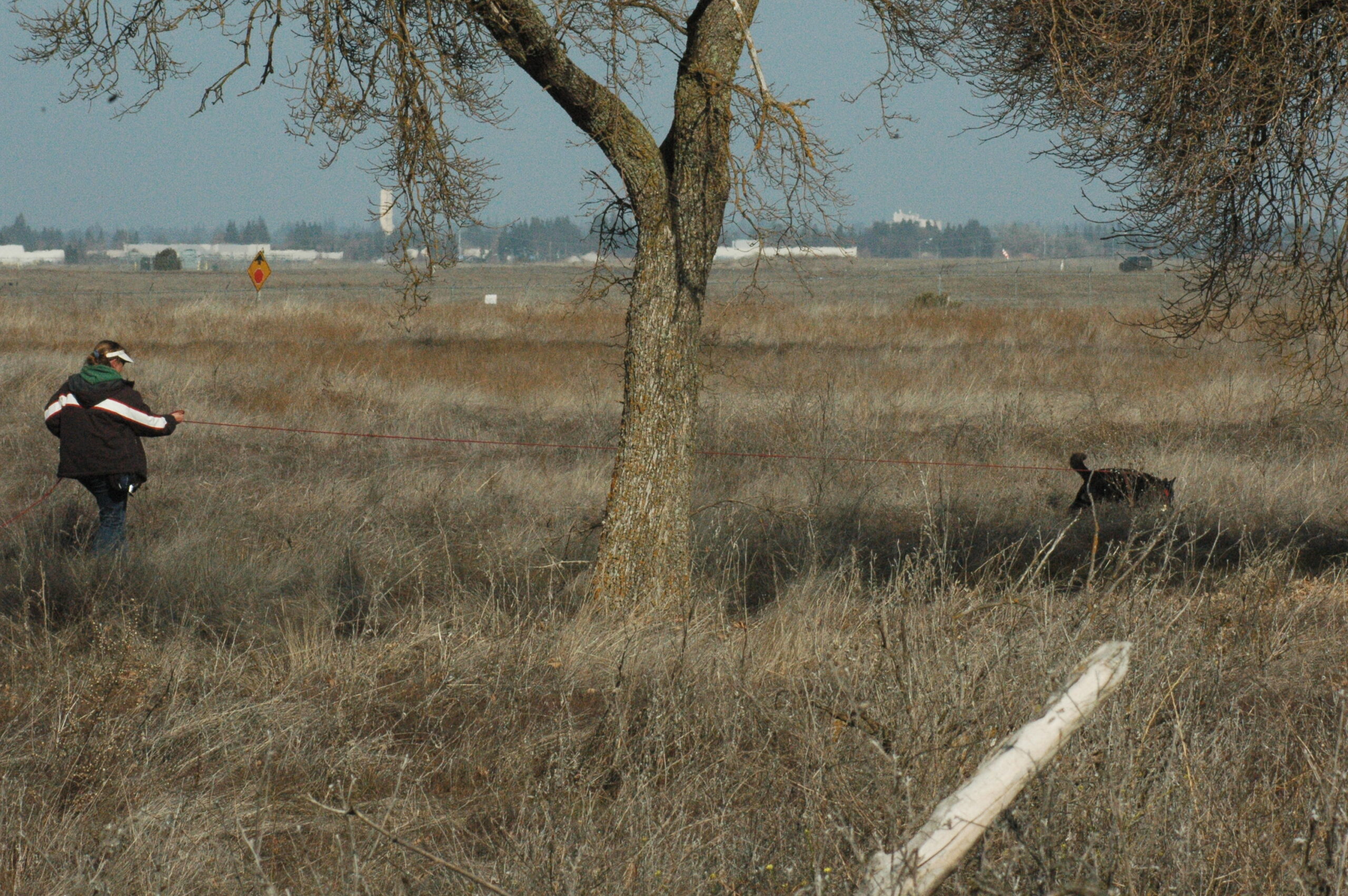
Most dogs really enjoy tracking! We use food or toys (whatever motivates the dog) to train and get the dogs excited about their track and finding the “articles” left on the track by the tracklayer. The picture shows Sumi, my Kai Ken, tracking in fields near Sacramento.
In the winter months, after rains have rejuvenated the grass in the fields, we enjoy tracking in the wild open spaces. After the fields have turned brown and the rattlesnakes and foxtails come out, we move to urban tracking, usually on college campuses, urban parks or business parks.
We train for American Kennel Club (AKC) style tracking, rather than the “footstep” tracking used in schutzhund or IPO. In this style, the dog must use their nose to follow the track on the ground, but not air-scent. However, some air scenting is fine, especially in urban tracking, but we want the dog to track the scent present on the ground.
EQUIPMENT
Regardless of the setting, the dog and handler need certain equipment. In addition, the tracklayer needs tools to help lay tracks, especially when training a dog to track.
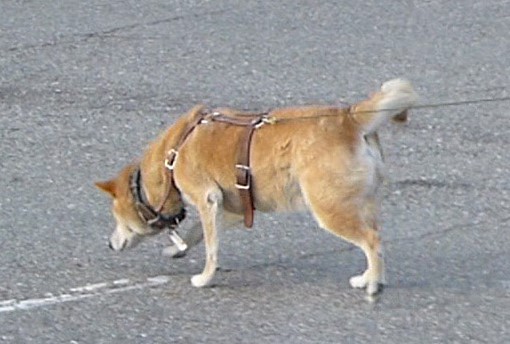
The dog must track wearing a non-restrictive harness. It can be made of any material, with the most common types being leather and cotton/polyester fiber. A line is used to connect the dog and handler. For field tracking, a 40 line is typically used, although urban tracking doesn’t necessarily call for such a long line. This picture shows Take, my Shiba Inu, tracking on asphalt.
The handler needs a water bottle (to provide hydration to the dog), as well as sturdy boots (especially for field tracking) and a reward for the dog when the end article is reached (in training, but NOT in tests). If the dog is a “strong puller,” gloves are also in order.
The tracklayer needs flags (“surveyor” flags of at least 18″ in height usually work well), articles for the dog to find on the track, sidewalk chalk (for urban training), and the dog’s food (provided by the handler) to put on the track and help the dog keep their nose on the track.
How we start

we meet
Depending upon the weather, we’ll meet at a park (for field training) or a local school (for urban training).

"Baby Tracks"
Using your food, I’ll lay a series of short “baby tracks” for your dog. At this point, you can use a flat collar and 6′ leash, but you will soon need to get a harness and a bit longer line (~10 feet is good to start).

Practice and Follow-up
You’ll practice with your dog, either laying your own “baby tracks” or having someone else lay them for you (I’ll show you how!). We’ll meet again on a regular basis. We’ll continue to add complexity to the tracks over time. Eventually, you’ll need a 40 foot line and will be working on full-length tracks.
Why Choose Us
01. Experience
I’ve been tracking and training tracking dogs for ~18 years. My dogs have been successful, as have my students. In addition, I’m an AKC and ASCA (Australian Shepherd Club of America) tracking judge.
02. TRAINING
I continue to add to my experience by training with other experts and continuing my education in the area of scent, etc.
Frequently asked questions
Click on the Resources tab for numerous recommendations for equipment, books, and training options, as well as information regarding tracking tests.
Are you ready to start tracking?
K9 Scentsability
About
Services
Service 1
Service 2
Resources
Blog
Contact
Join the Mailing List
Privacy Policy | Terms of Use | Cookie Policy
© 2023-2025 K9 Scentsability, All Rights Reserved.